
Braille Signage in Dubai: What the Code Actually Requires
Raised characters and braille are one deliverable, not two. What the Dubai Universal Design Code governs, why the numbers have to be checked against the code itself, and how tactile signage is built in ink rather than drilled and glued.
If a drawing on your desk says "ADA compliant signage" and the building is in Dubai, start there. ADA is the American standard. The instrument that binds a project in this emirate is the Dubai Universal Design Code. The market says ADA because consultants trained on American documents do. The code decides what gets inspected. Your specification only decides whether what arrives on site matches it.
Second: braille on its own is not accessible signage. The deliverable is raised tactile characters and braille on the same plate. A pack quoted as "braille signage" often comes back as braille added to a flat printed sign, which serves fewer readers than the code intends.
This page explains what the code governs and why each requirement exists. It does not quote mounting heights, character sizes or dot dimensions. Those figures are revised, they differ between authorities, and a wrong number on site is paid for in re-manufacture. Verify current values against the code and your authority, then put them on the drawings.
Is it ADA signage, or the Dubai Universal Design Code?
The two are not interchangeable. ADA is United States legislation with its own technical standard. The Dubai Universal Design Code is the accessibility instrument issued for this emirate, covering buildings and the public realm, and it is what a Dubai project is assessed against.
In principle they agree on the important things: tactile characters, braille beside them, contrast, a non-glare finish, and a mounting band a seated and a standing reader can both reach. The detail differs, and one thing has no American equivalent at all. Arabic. No US standard addresses Arabic tactile text or Arabic braille, so an ADA-spec plate cannot by itself satisfy a bilingual requirement here.
The fix is one line in the specification: name the governing document and its revision instead of writing "ADA compliant". If a drawing says ADA, ask which document the signs are to be built to.
What makes a sign accessible: raised characters and braille together
Accessible signage carries two readable systems on one plate: characters raised above the face so they can be read by touch, and braille.
They serve different readers. Many people who lose their sight in adult life never learn braille, and read a tactile character letter by letter with a fingertip instead. Readers who do use braille take information from the braille line far faster. Provide only one and the sign works for one of those readers and not the other.
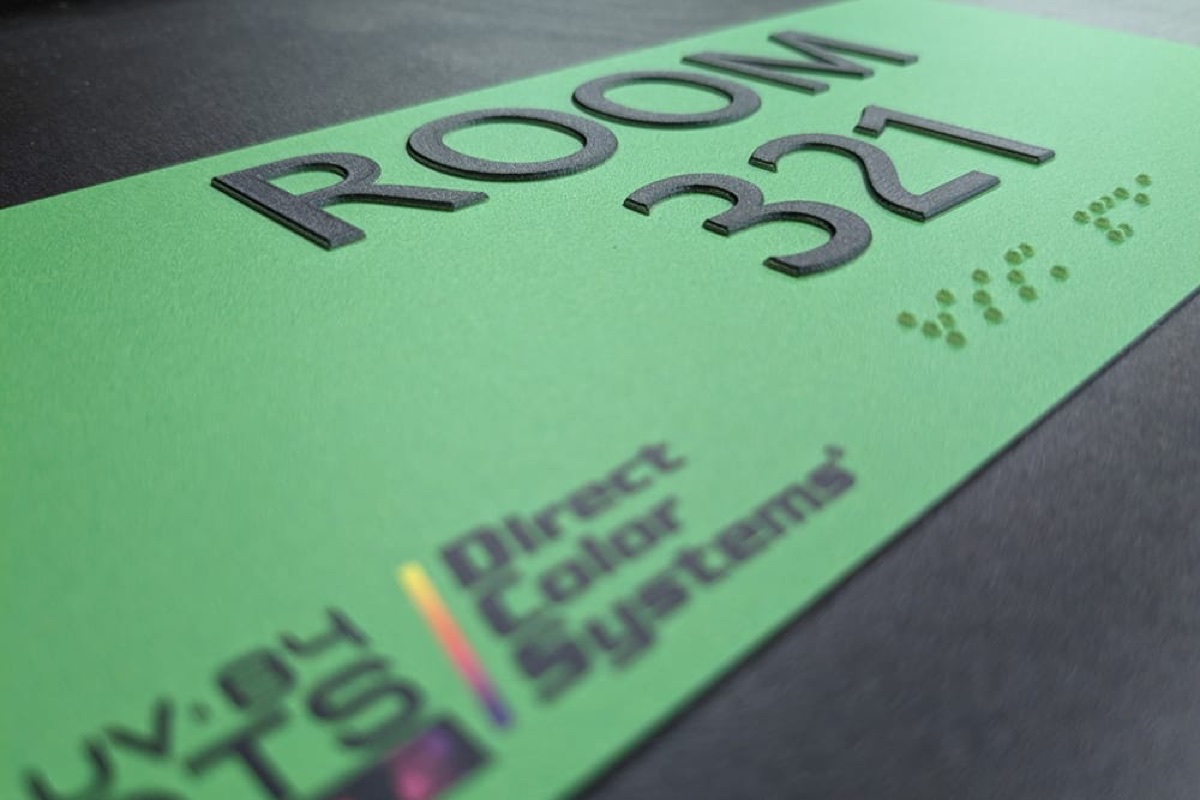
That is why the tactile signage requirements cover the character itself: raised by a defined amount, in a plain sans-serif face, no italics or fine serifs, spaced so a fingertip can separate the letters. Printed text that is merely thick is not tactile, and pictograms are raised the same way where required. Write the line item as "tactile raised characters and braille" and every supplier quotes on the same basis. Write "braille signage" and some of them will not.
Braille signage height: what the code fixes, and why this page will not give you a number
Mounting height is the most searched question here, and the number that counts is the one in force for your project on the day it is inspected.
Why a band exists at all is worth understanding. A tactile sign is read with a hand, so it has to sit where a hand comfortably reaches. Set it high and a wheelchair user cannot reach the braille. Set it low and a standing reader has to crouch. The code fixes a band both can use.
Position relative to the door follows the same logic. The convention the codes use is the latch side, a set distance from the frame, so a person sweeping the wall finds the plate in the same place at every door and is not standing in the arc of a door as it opens. Consistency is itself an accessibility feature: someone who cannot see the sign navigates by habit, and habit only works if the estate is uniform. Take the side and the offset from the code the same way you take the height, and mark both on the drawing.
The height itself comes from the code and is confirmed with your authority, not from a supplier's brochure. State the datum on the drawing too: character baseline, braille line or plate edge. A dimension without a datum is not a dimension, and site will guess.
Contrast and glare are the two requirements packs fail most often
Both are decided by material and finish rather than by artwork, which is why they are missed until a plate is already on a wall.
Contrast is a luminance requirement, not a colour one. Two brand colours can look like a strong pairing on screen and be almost identical in lightness, and low vision reads lightness. Convert the artwork to greyscale before approval. If character and background look similar with the colour removed, they are similar, and the plate will not read. Apply the same test to the plate against the wall behind it. The greyscale check is a quick screen, not the compliance measurement: the code sets the contrast requirement, and that is what the plate is measured against.
Glare is the other. A polished or high-gloss face reflects ceiling lights back at the reader and washes the characters out. Mirror stainless, mirror acrylic and a gloss varnish photograph beautifully at an angle and read poorly under a corridor downlight. Raised characters also help low-vision readers by casting a shadow, and gloss flattens it. Finish is set at order, not in the artwork: post-treatment is a UV-cured varnish, so the non-glare requirement has to reach the supplier before the plate runs, and be confirmed on the sample plate under the light the sign will actually live under. On accessible plates that is a compliance choice, not a taste one.
Bilingual Arabic and English signage needs two braille codes, not one
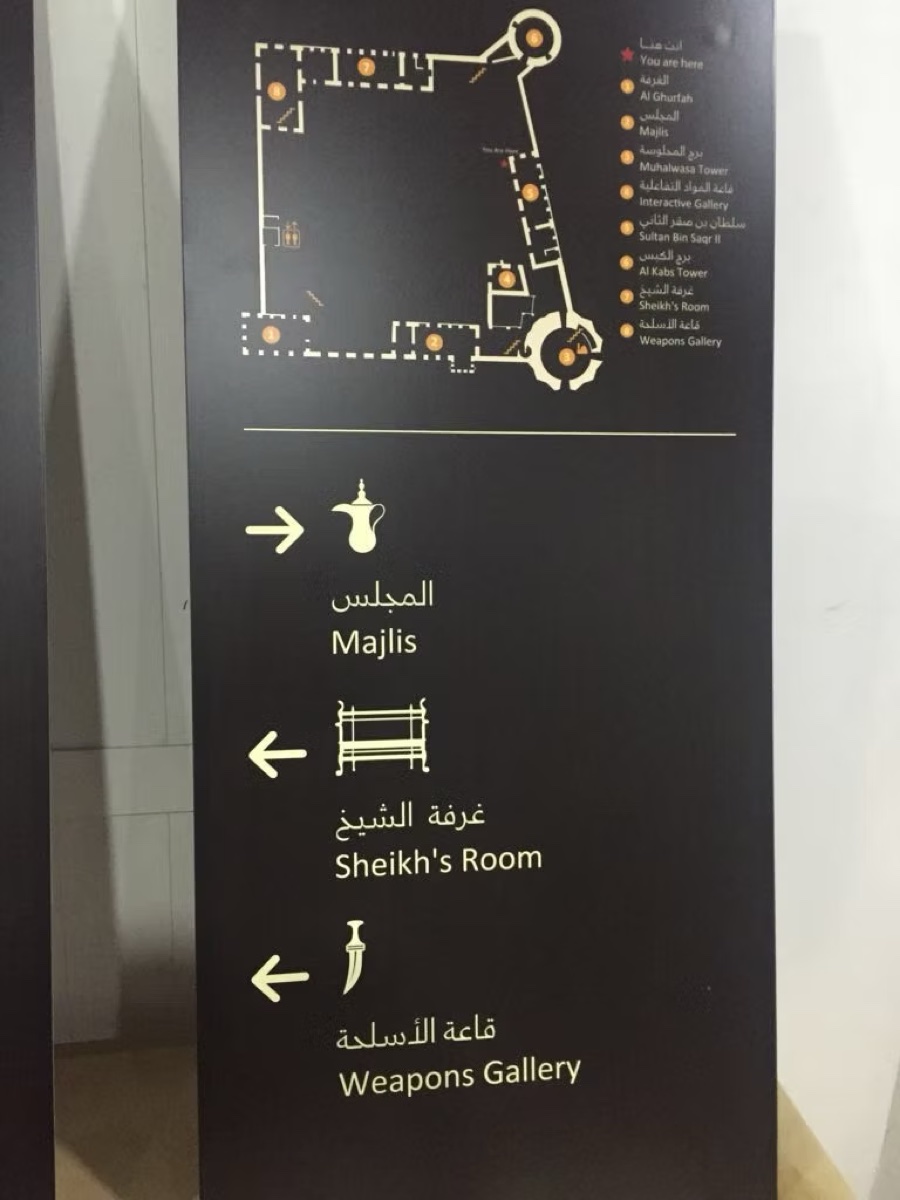
Bilingual signage puts two scripts, two reading directions and two braille codes on one plate.
Arabic braille is not English braille with the letters swapped. Unified Arabic Braille is the standard adopted across the Arab world so that a reader in Dubai and a reader in Cairo interpret the same cells the same way. Confirm your project specifies it and that the supplier is producing to it.
The next trap catches experienced designers: braille cannot be produced by applying a font. A braille font draws dot-shaped glyphs in place of letters; it does not apply the translation rules of the braille code. Artwork that looks convincing on screen can be meaningless under a finger. Braille has to come from a proper translation step and be proofed by hand, in both languages, before manufacture.
Arabic tactile characters need their own check. Arabic is a connected script with fine strokes and dots sitting off the letter body, so raising it legibly is not the same problem as raising a Latin capital. Ask what the code requires for Arabic tactile text, get a sample plate in your hands first, and keep the layout hierarchy identical on every plate so a reader learns once where the Arabic line sits.
Signage approval in Dubai: who checks, and what to have ready
The accessibility requirements travel with the code. The approval route travels with whoever owns the asset. A Dubai Municipality facility, a free zone, a master developer and a mall landlord do not necessarily route submissions the same way, so confirm the route before the pack is manufactured.
Most delays are not caused by artwork. They are caused by an incomplete submission: a schedule listing sign types but no mounting heights, no fixing method, no material and finish per zone, and no statement of which plates carry tactile characters and braille. That information exists on every project, spread across three consultants.
Four parts of that submission belong to the print supplier, so request them early and put them in with everything else.
Get the sample approved first. A sample plate is one plate. A rejected pack is the whole pack, and the programme behind it.
- substrate and finish per sign type, including the non-glare requirement
- the print build, layer by layer
- a sample plate with tactile characters and braille exactly as they will be produced
- artwork with the braille translation identified, in both languages, and the tactile geometry to be built
How braille is actually made: ink built up layer on layer, or drilled and glued beads
There are two routes, and they age differently on the wall.
The older route drills the plate and glues a plastic or metal bead into each hole. Every dot becomes an independent mechanical joint whose life depends on the fit of the hole and the adhesive. Signage loads those joints daily: fingers press, cleaning cloths drag, cleaning chemicals attack the adhesive, and the plate cycles between conditioned and outside air every time a door opens. The adhesive is usually the weakest element in that assembly, so where a plate does start to fail, that is where it fails first. Well-fitted, sensibly cleaned and out of the weather, glued braille can sit on a wall for years. The point is that every dot is a joint, and joints are the part of a sign that has a service life. A braille cell is six dot positions, and a missing dot turns one letter into another. A sign with a dot missing is worse than no sign, because it is confidently wrong.
The second route builds the dots in ink. On the Direct Color Systems UV84 flatbed, layered white ink raises the braille domes and the tactile characters, and the graphic prints over and around them in the same run. Nothing is inserted, so nothing can come out. The dot is the same cured material as the rest of the print, laid on the same adhesion promoter and sealed under the same UV-cured varnish, bonded to the panel rather than fitted into it. The graphic stack itself is thin, roughly 42 microns in total. The tactile element is not: the white is built up layer on layer until the dome stands at the height the code requires, and the raised character is built the same way, in the same run as the graphic and from one file.
Two more things follow on a large pack. Geometry comes from one file, so dome height, spacing and character height repeat identically from the first plate to the last. And the substrate opens up. Drilling needs a material that takes a clean hole and holds the bead, which narrows the choice in practice, while printed tactile lets the plate be the material the designer specified, including wood veneer, brushed aluminium and glass, because the dots are built on the surface rather than into it.
The Dubai Municipality parks and offices pack: how it was produced, and why one press matters years later
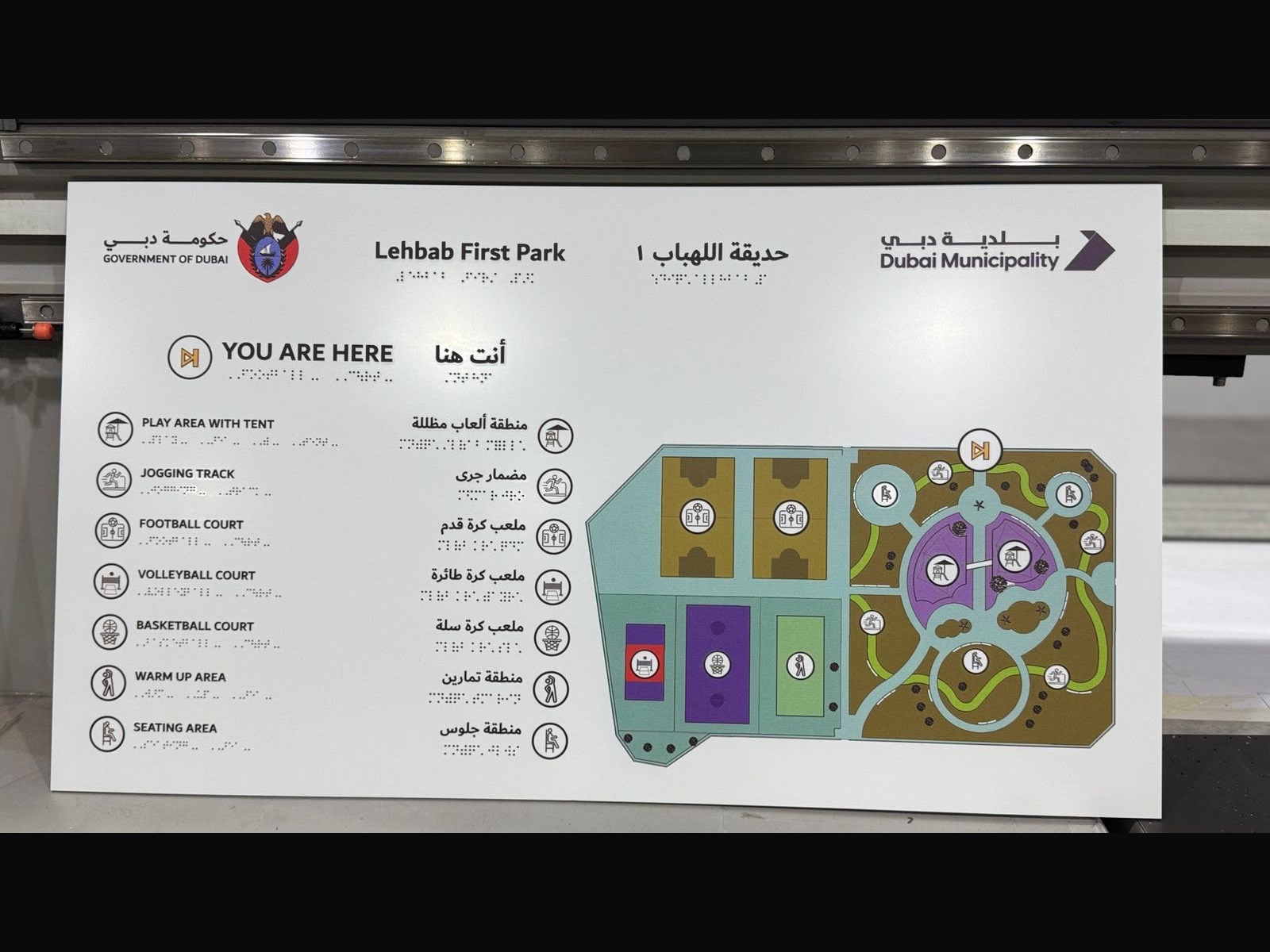
Sun Studio produced bilingual wayfinding and braille signage for Dubai Municipality parks and offices, with the braille built up in layered ink on the UV84 in the same run as the graphics.
Public realm is the hardest version of this job: bilingual by default, handled by the public, cleaned on a schedule, and outdoors carrying sun, dust and heat an office plate never sees. Every panel ran the same three stages. Pre-treatment on the Modico ModiTreat: cleaned, degreased, primed. Print: white base, CMYK, spot, with the tactile and braille layers built into the same file. Post-treatment: varnish, UV cured, tested. The tactile element is part of that stack, not an accessory fitted afterwards, and there is no drilled penetration through an outdoor plate for water and dust to sit in.
The other half of a public pack is time. Departments move, a park adds a zone, and plates ordered in year three sit beside plates installed at handover. Drift comes from re-sourcing, not from the press. Printing direct onto the finished material, a spot colour is profiled once per substrate and reused, and the white base at about 12 microns puts colour on a controlled white ground rather than on the material's own tone. Here that matters more than brand consistency, because contrast is a compliance property: a replacement plate printed slightly lighter can fail a requirement the original passed.
Common questions
Accessible signage is one of the few printed deliverables where a production decision carries a legal and a human consequence. Sun Studio has printed direct onto finished materials from Al Quoz First since 2011, and builds braille and tactile characters in layered ink on the same press that prints the graphic, on the material the project specified. Send the sign schedule, the substrates per zone and the tactile requirement per type, with the dimensions your code review has confirmed, and we will come back with a specification and a sample plate to approve before the pack is manufactured.
ملخص بالعربية
لافتات برايل والحروف البارزة: ما الذي يشترطه الكود فعليًا
الحروف البارزة وبرايل مُخرَج واحد لا اثنان. ما الذي ينظّمه كود دبي للتصميم الشامل، ولماذا يجب أخذ الأرقام من الكود نفسه، وكيف تُبنى اللافتة اللمسية بالحبر بدل الثقب واللصق. إن كان المخطّط على مكتبك يقول «لافتات مطابقة لـ ADA» والمبنى في دبي، فابدأ من هنا.
اقرأ المقال كاملاً بالعربية ←